
The Federal Theatre Project, 1935–1939: The Government Put Theatre Workers on the Payroll, and Congress Shut It Down in Four Years
The Federal Theatre Project ran from August 29, 1935 to June 30, 1939. At its peak it employed more than 10,000 theatre workers in 40 states. Its Living Newspapers turned housing, farming and electricity policy into stage plays. Its posters, scripts and photographs sit in the Library of Congress, free to use.
The Federal Theatre Project was the first federally supported theatre in the United States, and so far the only one run as a national programme. It was created in 1935 inside the Works Progress Administration (WPA), the New Deal work-relief agency, with a practical brief: theatre people were unemployed in the Depression, so the government would employ them at their own trade. It operated from August 29, 1935 to June 30, 1939, when Congress ended it.
A director with a promise
Harry Hopkins, who ran the WPA, recruited Hallie Flanagan, director of the Experimental Theatre at Vassar College, to lead the project. According to Flanagan's own account, repeated in the historical record since, Hopkins promised her a theatre that would be "free, adult and uncensored." Flanagan had studied European and Soviet theatre on a Guggenheim Fellowship in 1926, the first woman to receive one, and she built the project as a national system rather than a single company: regional units, touring productions, children's theatre, dance, vaudeville, circus, marionette shows, radio broadcasts and new plays alongside classics.
At its peak the project employed more than 10,000 people and operated in 40 states. The largest concentration was New York City, with 31 production units. Admission was charged for fewer than 35 percent of performances; the rest were free. A figure compiled by the National Archives and cited by the Living New Deal project puts the totals at nearly 64,000 performances for more than 30 million audience members across the project's life.
Flanagan's defence of the audience numbers, given after the project closed, is the clearest statement of what the programme proved: "We know now what many doubted four years ago — that great numbers of people, millions of them, who had never gone to the theatre, or had stopped going, want to go to the theatre if the plays are good and the admission reasonable."
The Living Newspaper
The project's most durable invention was a form: the Living Newspaper, a documentary play built from research, statistics and news reports, staged at speed with a large cast and direct address to the audience. The New York Living Newspaper unit produced a sequence of them on the policy fights of the decade:
- Triple-A Plowed Under (1936), on farm policy and the Supreme Court's invalidation of the Agricultural Adjustment Act.
- Power (1937), on electricity: public power, the Tennessee Valley Authority and flood control.
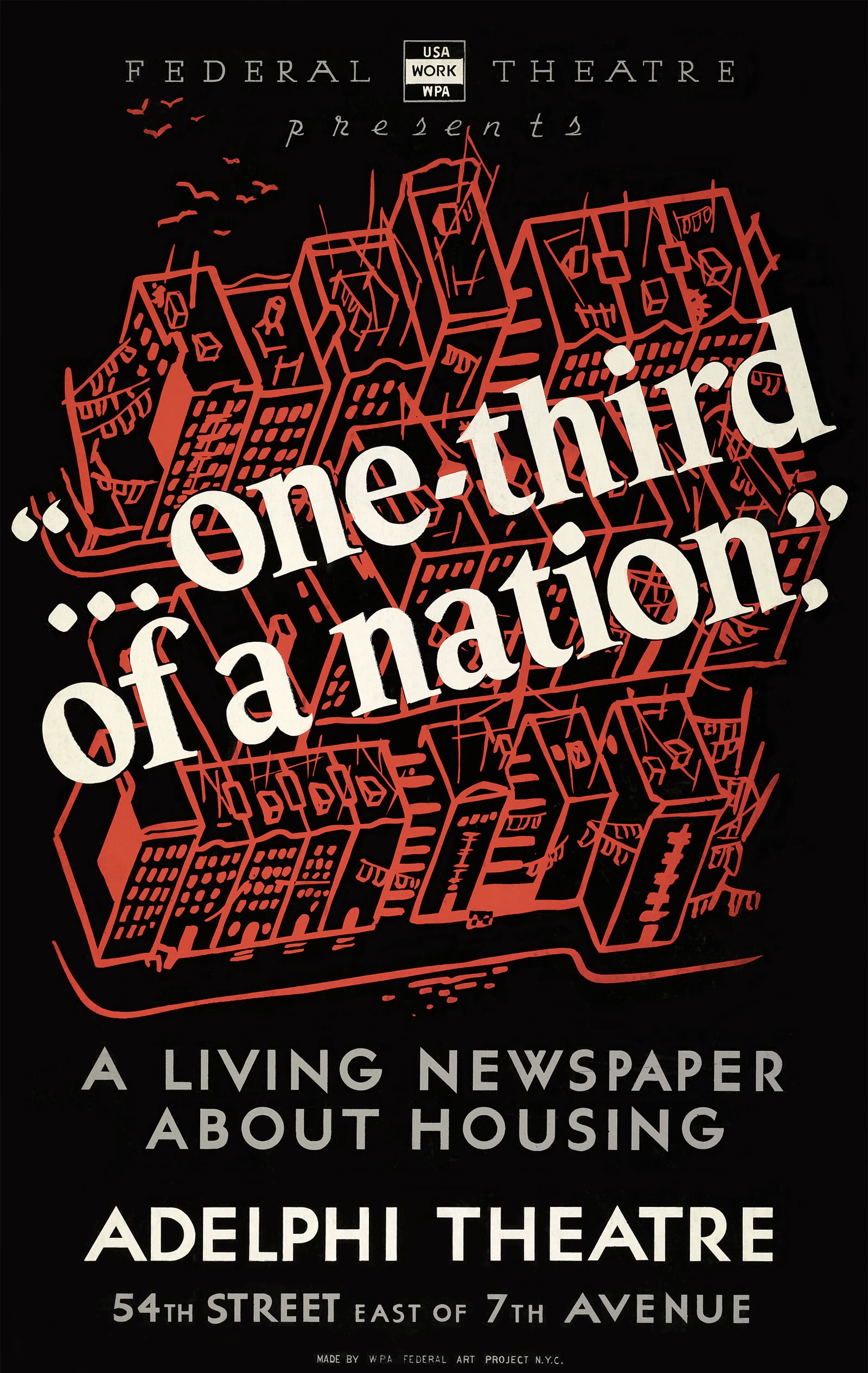
- One-Third of a Nation (1938), on housing. Its title quotes Franklin D. Roosevelt's second inaugural address of 1937: "I see one-third of a nation ill-housed, ill-clad, ill-nourished."
- Spirochete, on syphilis and public health, a subject commercial theatre would not have touched.
The form mattered beyond its subjects. Living Newspapers trained writers, researchers and actors to build a play out of documents, a method that runs through later American documentary theatre. They also made the project enemies, because a play about housing policy, staged by the government, reads to its opponents as the government arguing with itself in public, with actors.
Two productions that explain the range
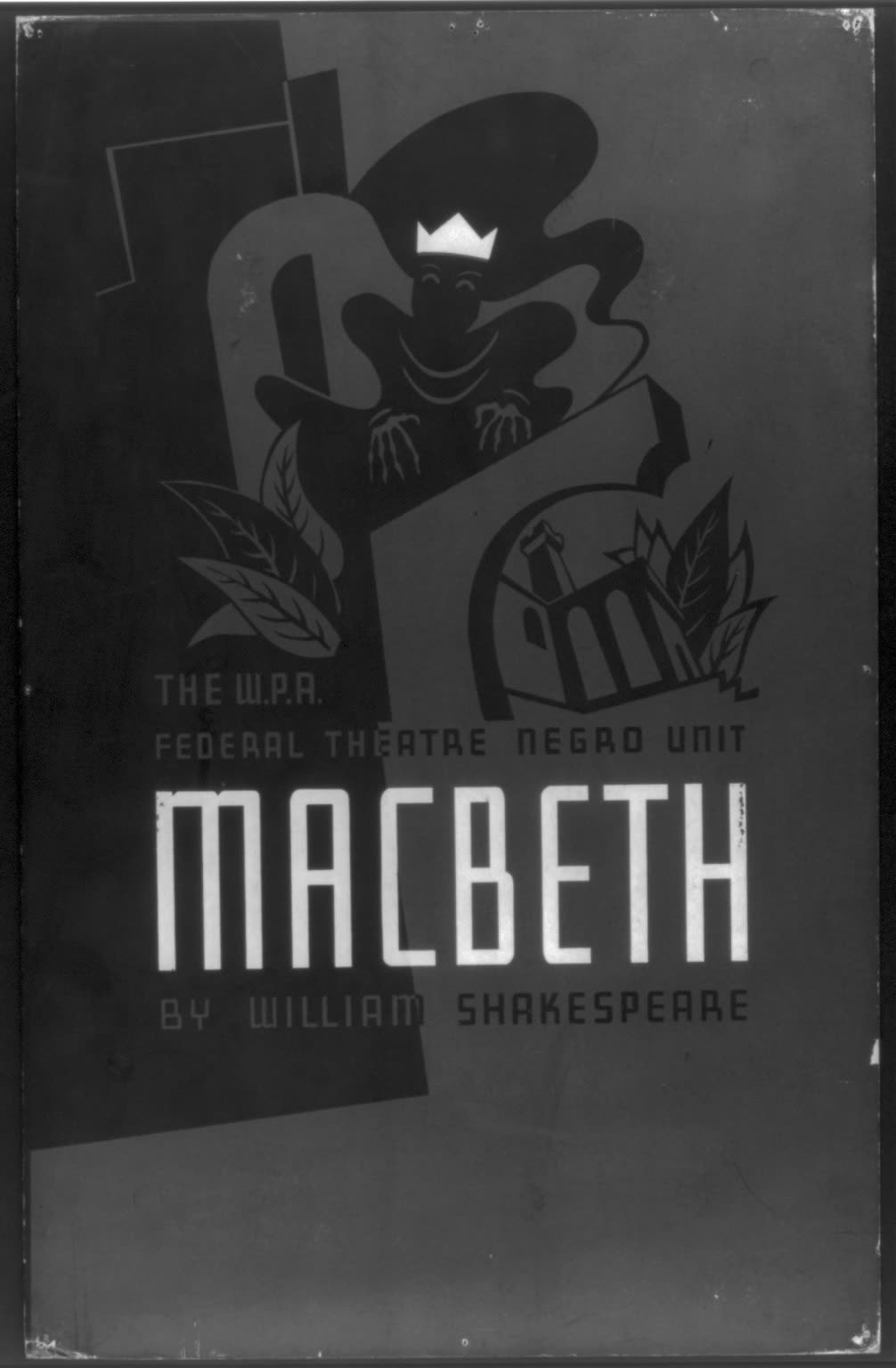
In Harlem in 1936, the project's Negro Unit staged Macbeth, directed by a 21-year-old Orson Welles, with an all-Black cast and the play reset in Haiti. It remains the project's most famous single production, and Welles and his producer John Houseman were both Federal Theatre alumni. Their next project, Marc Blitzstein's The Cradle Will Rock in 1937, became the project's most famous censorship fight, after WPA officials in Washington moved to delay its opening.
On October 27, 1936, Sinclair Lewis's anti-fascist play It Can't Happen Here opened in productions across the country on the same night, staged by project units in 22 cities. No commercial producer could have opened a play in 22 cities simultaneously. Only a national theatre could, and for one night, the United States had one.
Why it ended
The project was investigated by the House Committee on Un-American Activities, chaired by Martin Dies, and attacked in appropriations hearings over its politics, its racially integrated companies and casting, and its subject matter. Flanagan defended the programme before Congress. In 1939 Congress terminated the Federal Theatre Project by action on its funding, and the project closed on June 30, 1939. It was the only one of the WPA's arts projects to be ended outright by Congress rather than wound down.
Flanagan's retrospective judgement, quoted in the Living New Deal's record, was that the project's enemies "were afraid of the Federal Theatre because it was educating the people of its vast new audience to know more about government and politics… because it gave Negro actors as well as white actors a chance… because it epitomized too vividly the New Deal theory that every man who can work and can't find a private job should earn his way by doing useful work at his own profession or trade, for the government."
Why it still matters, in specifics
Three legacies are concrete rather than rhetorical.
First, the archive. The Library of Congress holds the Federal Theatre Project Collection: scripts, designs, photographs and posters, much of it digitised. The Library states that it is not aware of any copyright in the collection's materials, that works created by U.S. government employees, including for the Federal Theatre Project, are generally not eligible for copyright protection in the United States, and that such works are free to use and reuse, with the caution that the Library has not analysed every item and rights assessment remains the user's responsibility. This article's illustration programme, listed below, comes from that collection.
Second, the audience finding. The project demonstrated, with attendance in the tens of millions at free or low prices, that the limiting factor for American theatre audiences in the 1930s was price and access, not appetite. Every lottery, rush and subsidised-ticket scheme running today is built on the same finding.
Third, the unfinished argument. The United States has funded theatre since, through grants, tax policy and the National Endowment for the Arts (founded 1965). It has never again employed theatre workers directly, at national scale, to make plays. The Federal Theatre Project remains the only test of that idea, and it ran for three years and ten months.
Illustration programme: Library of Congress items identified for the images team
All items are in the Federal Theatre Project Collection, Music Division, Library of Congress. Per the Library's rights statement quoted above, items are free to use with a per-item check. Credit line specified by the Library: "Library of Congress, Music Division, Federal Theatre Project Collection."
1. One-Third of a Nation (1938), silkscreen poster. LOC exhibition item 071.00.00, Digital ID ftp0071. Via the LOC exhibition items page: https://www.loc.gov/exhibits/federal-theatre-project/exhibititems.html
2. One-Third of a Nation (1938), production photograph. LOC exhibition item 068.00.00, Digital ID ftp0068. Same page as above.
3. It Can't Happen Here (1936), silkscreen poster. LOC exhibition item 076.00.00. Same page as above.
4. Rehearsal photograph for The Cradle Will Rock (1937). LOC exhibition item 066.00.00, Digital ID ftp0066. Same page as above.
5. Macbeth playscript, Federal Theatre Project collection item. https://www.loc.gov/item/flrpd.07020006/
6. Collection overview for further poster selection (13,000+ digitised images: posters, stage and costume designs, photographs, scripts): "The New Deal Stage: Selections from the Federal Theatre Project, 1935–1939," Library of Congress. https://www.loc.gov/exhibits/federal-theatre-project/exhibititems.html