
The Swing's Week, in the Words of Performers Who Have Done the Job
A dozen tracks in the book, eight shows a week, and a call that can come at the half-hour: the cover system that keeps productions running, described by the performers who work it — drawn from the interviews they have given to Playbill, Mental Floss and BroadwayWorld.
First, the definitions, from the union
Playbill put the basic question to Actors' Equity Association, the union that represents actors and stage managers. Its spokesperson, Maria Somma, gave Playbill the working definition: a swing is "a non-performing member of the chorus who goes on when a member of the chorus is absent or [is] performing as an understudy in place of a principal." A swing, in Somma's phrase, functions as an understudy to the chorus.
The three cover jobs are distinct, and Mental Floss's reporting, built on interviews with understudies and standbys, sets them out cleanly:
- A swing is offstage, covers ensemble tracks, and may cover many of them.
- An understudy performs every night in the ensemble and also covers a principal role.
- A standby is offstage, covers only principal roles, and waits.
Josh Breckenridge, a standby in Come From Away, explained the distinction to Mental Floss: "Standbys are off-stage, and cover only principal roles. They literally stand by. They're required to be at the theater, and in some cases, within a certain radius of the theater, to be on call if a principal role is unable to perform. Understudies are on-stage, every night, in a specific [ensemble] role, and they cover principal roles. Swings are off-stage and cover ensemble."
The chain: one absence moves three people
The system is a chain, and Breckenridge's account to Mental Floss describes how a single absence travels through it. If a principal is out, the standby goes on. If the standby is also out, the understudy steps up into the principal role. A swing then swings in to cover the understudy's ensemble track. One sick call can therefore change the assignments of three performers before the half-hour call.
Jay Douglas, who worked as both a swing and assistant dance captain in The Drowsy Chaperone, told Playbill that his own contract crossed the categories: "There are standbys and then there are swings, and I'm sort of a combination of a swing and a standby. I swing two ensemble men in the show, but then I am also technically a standby for four of the principal players."
The arithmetic: tracks, not roles
Ensemble parts are organised as tracks: the fixed sequence of entrances, choreography, costume changes and positions that one ensemble member performs across a whole show. A swing's job is measured in tracks, and the numbers in published reporting are large.
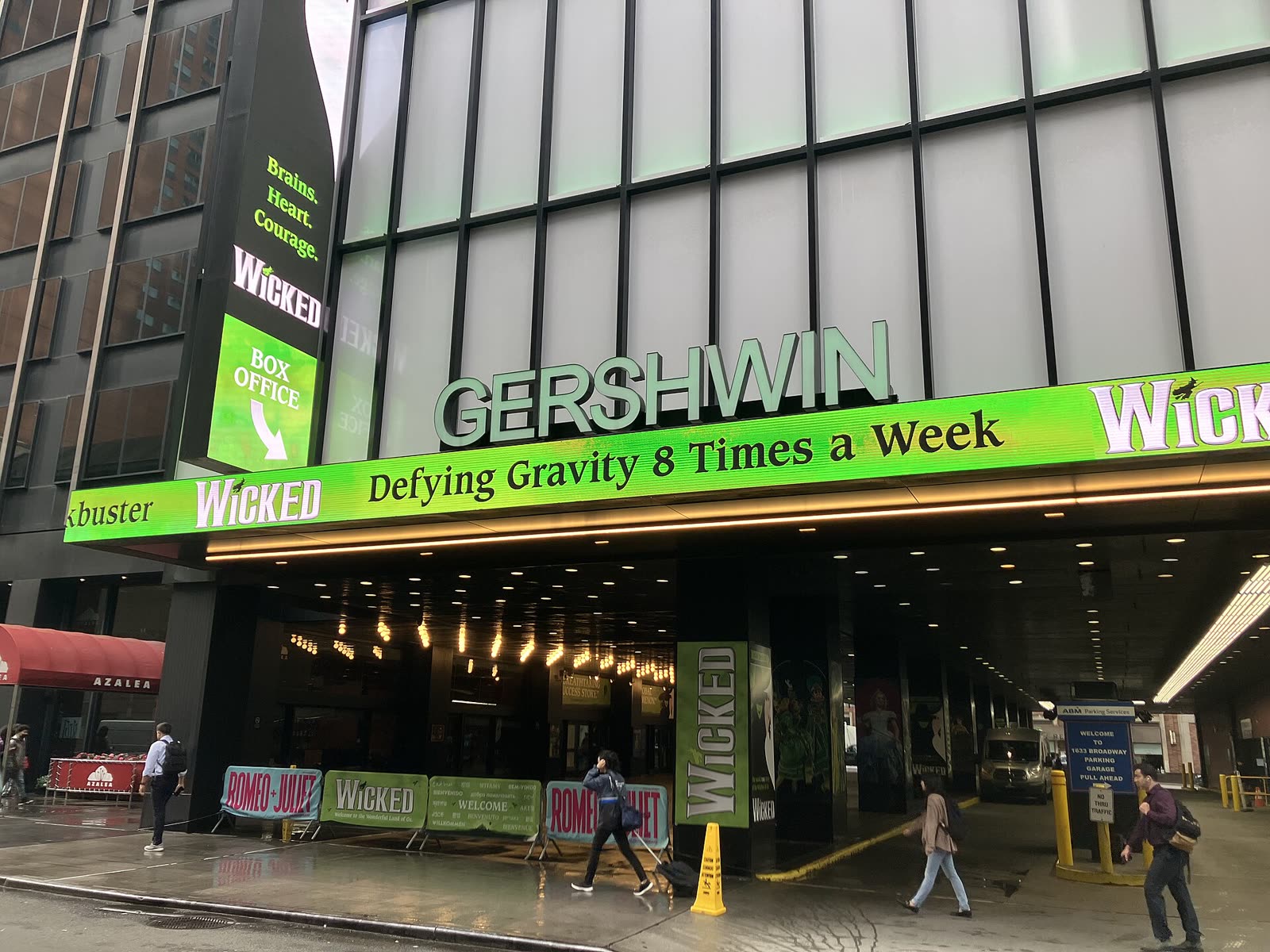
Playbill's "Understanding Broadway: The Swing" profiled two Wicked performers. Brian Wanee covered 12 tracks. Lindsay Janisse, also the production's dance captain, covered five. Between them, Playbill reported, they covered more than 15 ensemble tracks in one production.
Emma Grimsley, who performed in the touring company of The Phantom of the Opera as an ensemble member and Christine understudy, put the swing's load in comparative terms in a BroadwayWorld interview: swings "know sometimes 15 different tracks. We've had swings go on mid show. We've had swings go on last minute, and they just look at their book and go alright who am I today? This person. And they go and they do it."
The book Grimsley mentions is literal. Swings maintain written records of each track they cover, because no performer performs every track often enough to hold them all in the body at once.
The week itself: rehearsal that never ends
A principal's preparation mostly ends at opening. A swing's does not, because a track performed once in March may be needed again, without notice, in October. Wanee told Playbill: "Covering 12 tracks, you're constantly trying to learn the show again — even after two and a half years. There are tracks that you don't do for six months or so. I try to watch the show every now and then and go over notes because something can happen where you go on for two people and if you don't know the tracks inside and out, the show won't look polished."
Janisse described the onstage version of the same problem to Playbill. Performing several tracks in one week produces what she called the "swing-thing": "When you do several different roles in a week, you get the 'swing-thing,' where you're on stage saying to yourself, 'Who am I?'"
Grimsley's BroadwayWorld interview adds the understudy's version of the discipline. Covering Christine while performing her own ensemble track in Phantom, she described keeping the two separate: "at this moment when the music does this thing, as an ensemble member I'm gonna go here, but if I'm on as Christine I'm gonna go here. It's keeping the tracks clear in my mind." Her company's backstage shorthand, as she reported it: "it's all in the costume. Once you've done it a couple of times whatever costume you have on knows where to go."
The universal swing: the job, in several cities
Playbill's reporting adds one harder variant. Wicked has multiple productions running at once, and the production employs what it calls a universal swing: a performer who covers ensemble tracks across companies, travelling between them. Janisse told Playbill: "It's a massive undertaking. There are little differences [a universal swing] has to know for every company they go to." The same track, staged by the same creative team, is not identical in every city, and the universal swing's book has to hold the differences as well as the track.
What the published record says the job is
Across these interviews, published over a span of years by three outlets, the description stays consistent. The swing's week is not eight performances. It is eight performances' worth of readiness: maintaining a book of tracks, watching the show from the house to refresh tracks gone stale, rehearsing covers that may not be used for months, and being assignable, at a half hour's notice or mid-show, to any of a dozen positions in the choreography.
Mental Floss's reporting notes one structural fact underneath all of it: under the Actors' Equity rulebook, Broadway productions are required to carry understudies. The cover system is a contractual obligation, staffed by the performers quoted above, and it is the reason a Broadway performance almost never cancels for a single absence.
The next time a cast board in a lobby carries a slip of paper announcing a change, the chain Breckenridge described has already run: standby or understudy up, swing in behind them, book open backstage to the right page.
Drawn from interviews published by Playbill, Mental Floss and BroadwayWorld.